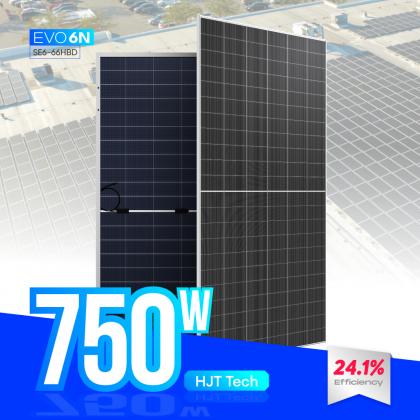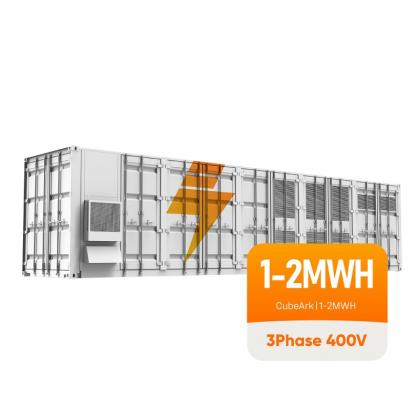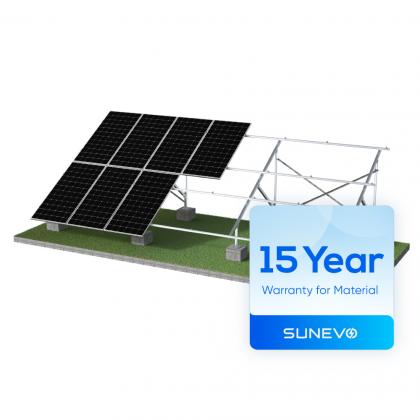
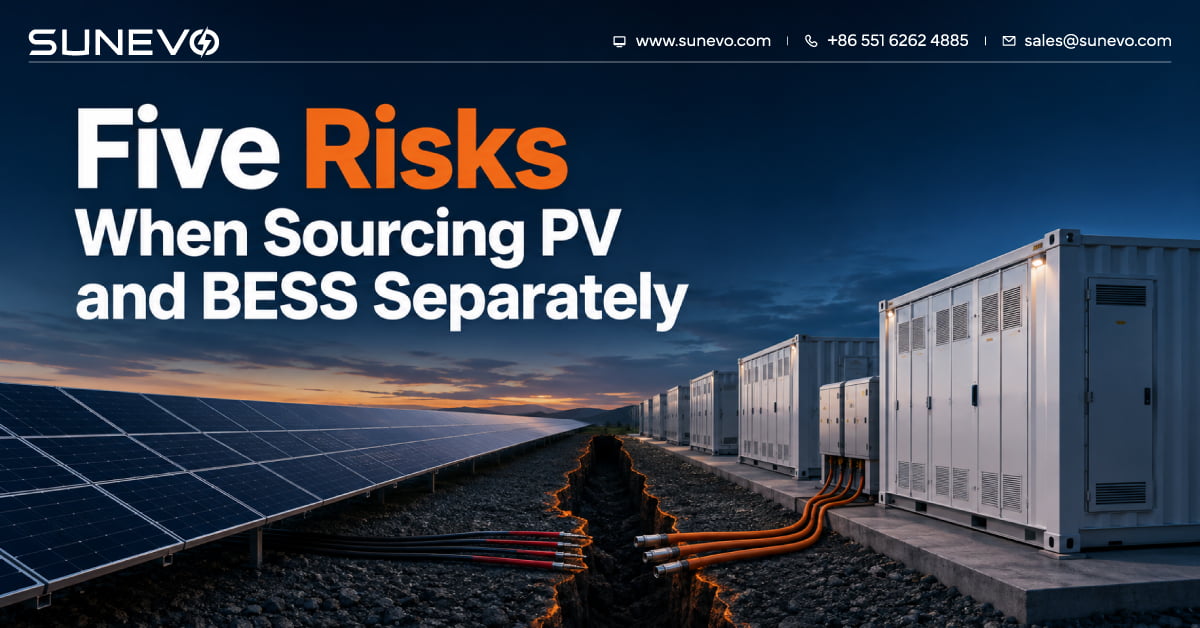
For EPC contractors, project developers, and commercial energy users, buying solar PV equipment and battery energy storage systems from different suppliers can appear attractive. It allows more product choices and may reduce the initial purchase price.
However, a lower equipment quotation does not always mean a lower total project cost. Once installation begins, the buyer may have to manage system compatibility, technical coordination, commissioning, warranties, and after-sales support across several companies.
Before separating PV and BESS procurement, buyers should understand the following five risks.
A PV inverter, PCS, battery system, and EMS may each meet their own technical specifications, but that does not guarantee smooth system-level operation.
Buyers may encounter problems such as:
· Battery voltage not matching the PCS operating range
· BMS and PCS communication failures
· Unsupported CAN, Modbus, or Ethernet protocols
· Charging and discharging limits that cannot be coordinated
· EMS control logic that does not match the project’s operating strategy
· Different firmware versions affecting communication
The result may be frequent alarms, restricted battery output, incomplete state-of-charge data, or an inability to operate the system as designed.
For buyers, the key question is not simply, “Are these products certified?” It is: “Have these exact models and software versions been tested together?”
When a complete system comes from several suppliers, responsibility can become unclear when something goes wrong.
The battery supplier may say the PCS settings are incorrect. The PCS supplier may blame the BMS communication. The EMS provider may argue that the required data is not being supplied correctly.
Meanwhile, the buyer or EPC contractor must coordinate the investigation, arrange technical meetings, collect operating data, and manage the project delay.
Before placing orders, buyers should define one responsible party for:
· Overall system design
· Communication integration
· Parameter configuration
· Protection coordination
· Factory testing
· On-site commissioning
· Performance acceptance
Without a clear responsibility matrix, the buyer may effectively become the system integrator.
PV modules, inverters, batteries, PCS units, and EMS platforms normally have different warranty terms and operating conditions.
A battery warranty may depend on:
· Maximum charge and discharge current
· Depth of discharge
· Operating temperature
· Annual energy throughput
· Number of cycles
· State-of-charge limits
If another supplier’s equipment operates the battery outside these conditions, warranty responsibility may be disputed.
Buyers should therefore review the warranty at the system level. It is important to confirm whether the warranty covers only defective components or also includes fault diagnosis, replacement parts, transportation, labor, software updates, and on-site service.
Separate quotations often make individual components look less expensive. But buyers should also calculate the cost of making those components work together.
Additional expenses may include:
· Third-party system engineering
· Communication gateways
· EMS customization
· Software or firmware modifications
· Repeated factory testing
· Additional commissioning days
· Overseas technical support
· Replacement of incompatible equipment
Project delays can also create financing costs, installation downtime, or missed grid-connection deadlines.
For this reason, buyers should compare the total cost of ownership rather than only the equipment price.
A system may be successfully energized but still fail to deliver the expected commercial results.
For example, it may not achieve the required:
· Peak-demand reduction
· PV self-consumption rate
· Backup duration
· Charging and discharging power
· Usable battery capacity
· Response time
· Round-trip efficiency
This often happens when the PV system, BESS, and EMS are designed separately without one coordinated operating strategy.
Before procurement, buyers should define clear acceptance criteria based on the actual application. These may include usable energy, continuous power, system response time, operating modes, communication stability, and performance under representative loads.
If PV and BESS must be purchased separately, buyers should request the following before signing contracts:
1. A complete electrical single-line diagram
2. Written confirmation of equipment compatibility
3. Communication protocols and signal lists
4. Approved battery charging and discharging parameters
5. A system-level control and protection strategy
6. Factory acceptance testing procedures
7. A responsibility and warranty matrix
8. On-site commissioning and after-sales support plans
9. Measurable system performance acceptance criteria
Not necessarily.
Separate procurement can work well when the buyer or EPC contractor has strong system-integration experience, controls the complete technical design, and has clearly defined the responsibilities of every supplier.
The risk increases when equipment is selected mainly by price and integration is left until installation or commissioning.
For B2B buyers, sourcing solar PV and BESS separately is not simply a purchasing decision—it is a system-integration decision.
The main risk is rarely one defective product. It is the gap between multiple products, software platforms, suppliers, warranties, and service teams.
Before comparing quotations, buyers should identify who will be responsible for making the complete solar-plus-storage system operate safely, reliably, and according to the project’s financial objectives.



 サポートされているipv6ネットワーク

 English
 français
 Deutsch
 italiano
 español
 português
 العربية
 Polski
 ไทย
ไทย